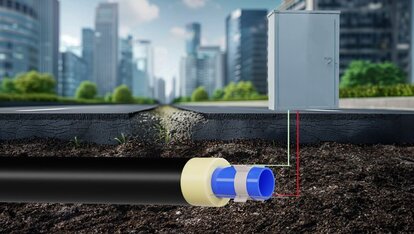
Sustainable district heating networks are becoming increasingly important for local authorities and businesses looking to utilise renewable energy and reduce their long-term reliance on fossil fuels. However, as these systems expand, so do the demands placed on them. District heating pipes must be optimised for their specific application, while providing a long service life. They should also be recyclable, cost-effective and versatile, while helping to minimise CO₂ emissions throughout their lifecycle.
Whether for new build projects, extensions or system modernisation, aquatherm supports local authorities, energy providers, planners, suppliers and businesses in implementing high-performance district heating networks – with suitable pipework systems, technical expertise and proven solutions for a wide range of requirements within the local and district heating sectors.
Requirements for district heating pipework
In modern district heating networks, pipework is exposed to significant thermal and mechanical stresses. In addition to consistently high operating temperatures and fluctuating pressure conditions, systems must reliably withstand external environmental influences for decades.
When designing a district heating network, factors such as route planning, heat loss, pressure loss, connection density and future network expansion are all critical considerations, alongside the choice of material and insulation.
Key requirements include:
- High-performance insulation to minimise heat loss,
- Reliable sealing systems,
- Effective corrosion protection, and
- Very low energy losses throughout the pipeline system.
While traditional materials such as steel can result in high installation and maintenance costs, polypropylene pipework systems, such as those developed by aquatherm, provide a low-maintenance alternative. They offer particular advantages when constructing and expanding a district heating networks due to their ease of installation: thanks to fusion technology, pipes can be welded together quickly, safely and with a permanent seal – completely without the need for open flames. This ensures maximum operational safety, supports the long term reliability of the network and helps to minimise future maintenance requirements.
Applications of AQUATHERM pipework systems for district heating networks
Whether for local authorities or industrial applications, aquatherm pipework systems provide flexible solutions for a wide range of applications within the heat network sector. They are suitable wherever heat needs to be reliably distributed between multiple buildings, neighbourhoods, commercial premises or public facilities – from local heating networks to larger district heating systems serving communities and municipalities.
Neighbourhood developments, energy providers, schools and public buildings benefit from a reliable heat supply with aquatherm systems, which are designed for an estimated service life of more than 50 years.
As part of local authority heat planning, neighbourhood development and the decarbonisation of public buildings, aquatherm pipework systems are ideally suited to infrastructure projects focused on renewable energy.
From the construction of new heating networks to the expansion of existing infrastructure, aquatherm systems help deliver reliable and cost-effective district heating solutions. Their ease of installation, corrosion-resistant material properties and low thermal conductivity support efficient implementation which helping to reduce long-term maintenance requirements.
In business parks, industrial sites or data centres, consistent operating temperatures and a high level of supply reliability are essential. District heating is particularly relevant for businesses where several buildings, production areas or technical facilities are supplied via a shared heating network. Here, robust district heating pipework systems that can withstand demanding operating conditions and ensure long-term reliability prove their value.
When constructing, expanding or modernising a district heating network, existing infrastructure, new connection points and future energy sources must be considered at an early stage. aquatherm supports planners and energy providers with technical advice and suitable pipework systems that can be cost-effectively integrated into both existing and new heating networks – from connecting additional buildings to integrating hybrid energy systems.
AQUATHERM ENERGY: The right pipework for district heating
aquatherm energy is an effective solution when district heating pipework needs to be cost-effective, corrosion-resistant and easy to install. This pre-insulated pipework system was developed for modern district heating infrastructures. The three-layer construction – comprising a PP-RCT inner pipe, PUR insulation and an HDPE outer jacket – provides high levels of thermal insulation and protection, while being lighter than steel pipes and offering high flexibility during installation.
Thanks to its high chemical and thermal resistance, the pipework system is suitable for the construction of new district heating networks as well as the expansion of existing heating infrastructure. The system supports reliable heat distribution for cities, local authorities and energy providers, as well as district heating applications for businesses – cost-effectively and ‘Made in Germany’.
Advantages of AQUATHERM for district heating network expansion
When expanding district heating networks, rapid installation, low heat loss and long-term reliable operation are key considerations. A pre-insulated pipework system for district heating, featuring a corrosion-resistant PP-RCT inner pipe, integrated PUR insulation and a robust HDPE outer jacket, offers advantages through its low weight compared to steel pipes (Comparative LCA: weight of 100 ft of pipe: AQUATHERM blue: 7.44 kg; copper pipe: 13.5 kg; steel pipe: 48 kg).
The efficient fusion connection technology also simplifies installation. An optional leak detection system provides additional monitoring capability and supports operational reliability within the district heating network.


Practical Projects: District Heating Networks with AQUATHERM
aquatherm energy, a thermally insulated pipework system, was used for the expansion of the existing district heating network in Gateshead. Compared with the steel pipework originally used, this helped to reduce construction times, minimised disruption to traffic and lowere installation costs. The project demonstrates how aquatherm pipework can support the expansion of district heating networks in densely populated urban areas.
At the geothermal heating plant operated by Stadtwerke Schwerin, aquatherm pipework systems form part of a district heating solution using renewable energy sources. The plant utilises medium-depth geothermal energy and heat pumps to supply part of Schwerin’s district heating with renewable energy in the future.
The pipework in the machine house required particularly corrosion-resistant materials due to the high mineralisation of the thermal water and operating temperatures ranging from 50 to 70 °C. The project demonstrates how aquatherm supports district heating projects that integrate renewable energy sources into existing heating networks.
About the project
AQUATHERM's Partnerships in District Heating Network Expansion
When it comes to district heating network expansion, aquatherm supports planners, suppliers and specialist contractors from the technical design stage through to implementation. The district heating pipework is tailored to the network size, route, operating conditions and installation requirements – supporting heating networks that can be installed, expanded and operated reliably.


Frequently Asked Questions About the District Heating Network with AQUATHERM
A district heating network is particularly worthwhile where several buildings, neighbourhoods or public facilities are supplied with heat through a shared system over the long term. Typical areas of application include new-build developments, local authority regeneration projects, energy provider projects, commercial estates or larger corporate sites. Key factors include sufficient connection density, long-term heat demand and the ability to integrate renewable heat sources or waste heat into the system.
CO₂ emissions from district heating can be lower than those from fossil fuel heating systems, particularly where renewable energy sources are used. According to the Federal Environment Agency (2024/2025), district heating in Germany emits between 198 and 254 g CO₂/kWh, depending on the individual network. By comparison, gas heating systems emit around 247 g CO₂/kWh, while oil heating systems emit around 318 g CO₂/kWh.
District heating can also competitive in terms of cost. A recent analysis of 576 heating networks (vzbv, April 2025) shows a nationwide median price of 17 Ct/kWh (gross). In around 27 % of networks, prices exceed 20 Ct/kWh, and in just under 9 % they are above 25 Ct/kWh. District heating can also offer greater protection against future increases in CO₂ pricing, as it is less directly dependent on fossil fuel sources.
(Source: Federal Association of Consumer Organisations (2025))
When expanding a district heating network, technical, economic and structural requirements must be carefully balanced. These include investment costs, civil engineering works, route planning, pipe sizing, heat losses, connecting new buildings and integrating existing sections of the network. aquatherm supports planners, suppliers and operators throughout this process with suitable pipework systems and technical advice for new builds, extensions and modernisation.
A future-proof district heating network is planned in such a way that it reliably meets current heating demands while allowing for future expansion. Key factors include low heat losses, modular pipework systems (e.g. made of polypropylene), flexible network structures, digital network control and thermal storage. This allows the network to be adapted step by step to accommodate new connections, changing energy sources and increasing demands on the heat supply.