Tackling the major challenges of the future today with innovation and state-of-the-art materials
The construction industry faces considerable challenges. In particular, reducing greenhouse gas emissions to meet the climate targets that have been set is a major task for all those involved. We recognised these challenges at an early stage. Our answer: materials designed with the future in mind.
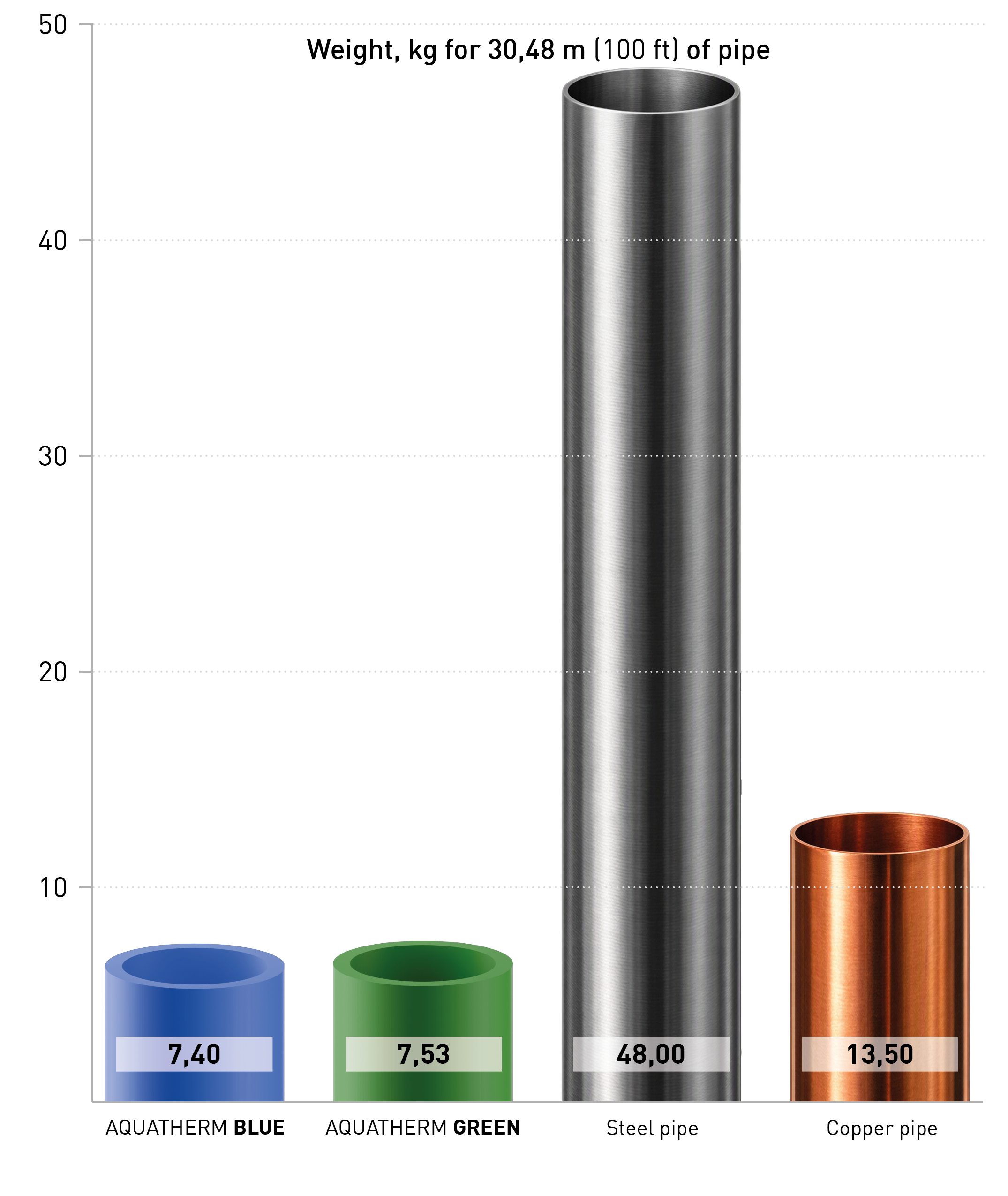
Our polypropylene (PP-R/PP-RCT) pipework systems can be used in many areas – for example, for drinking water, data centres or district heating. Compared with traditional materials such as copper, steel or PVC, they offer clear advantages: lower CO₂e emissions (up to 37 per cent lower), significantly lower weight (up to 85 per cent lower) and a reduced environmental impact due to lower nitrogen oxide emissions during manufacture (up to 61 per cent lower).
Combined with outstanding properties such as corrosion resistance and 100 per cent recyclability, our polypropylene pipework systems offer our customers an effective solution across all sectors.
Cradle to Gate – The advantage starts right at the manufacturing stage
The ‘ecological footprint’ that a pipework system is determined from the outset by the choice of material and the manufacturing process.. We use polypropylene for our pipework systems – and for good reason.
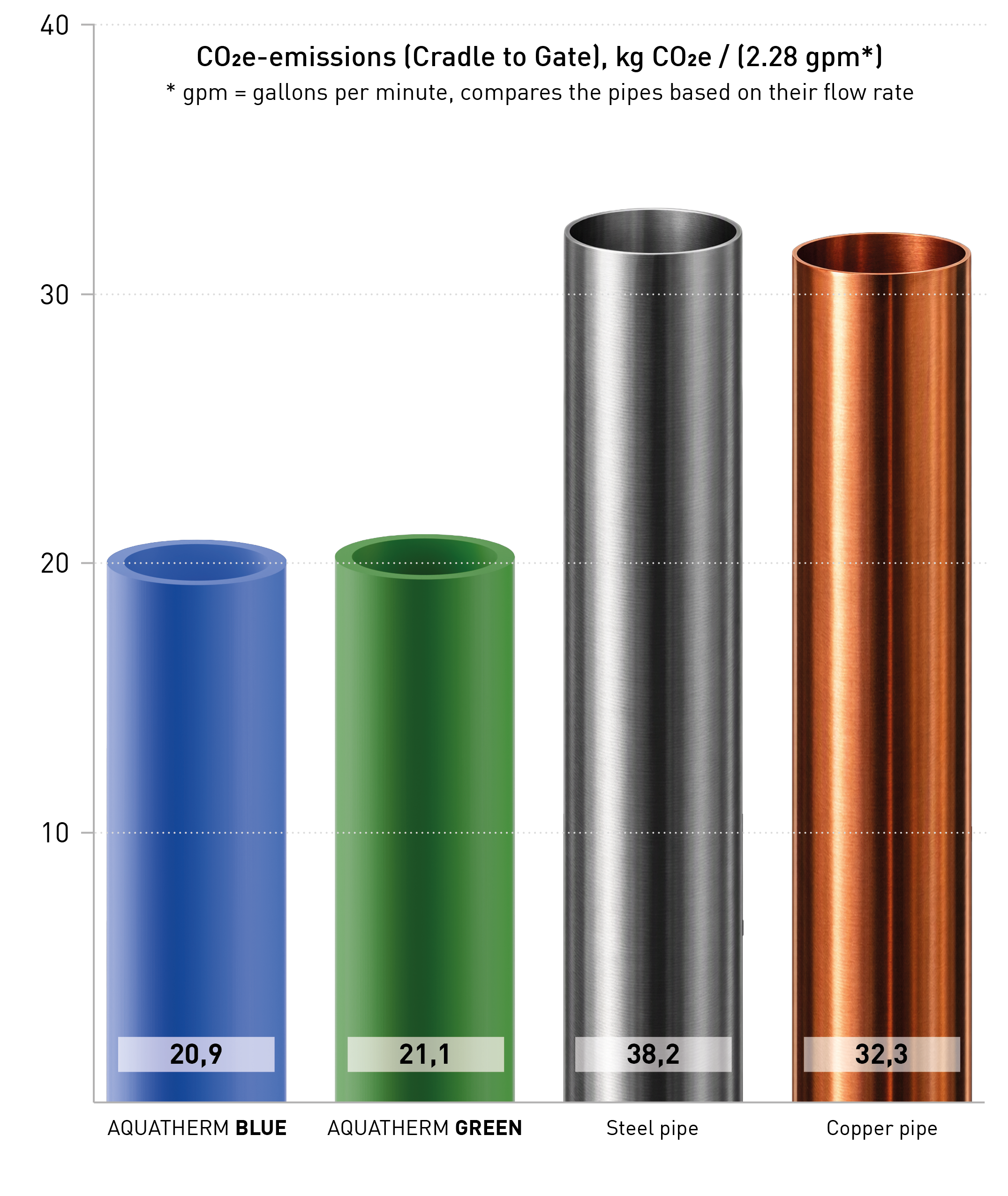
For example, the production of aquatherm green generates around 35 per cent fewer greenhouse gas emissions than a comparable copper system. With aquatherm blue, emissions are even around 37 per cent lower than with a steel pipework system. The lower Global Warming Potential (GWP) is therefore a clear advantage. Polypropylene also performs better than conventional materials when it comes to sulphur and nitrogen oxide emissions during production. For example, the acidification potential in the manufacture of steel pipes is up to 350 per cent higher than that of aquatherm blue.
- Up to 37 per cent fewer CO₂ emissions
- Up to 150 per cent lower smog formation and ground-level ozone levels (so-called summer smog)
- Up to five times lower acidification potential from sulphur dioxide
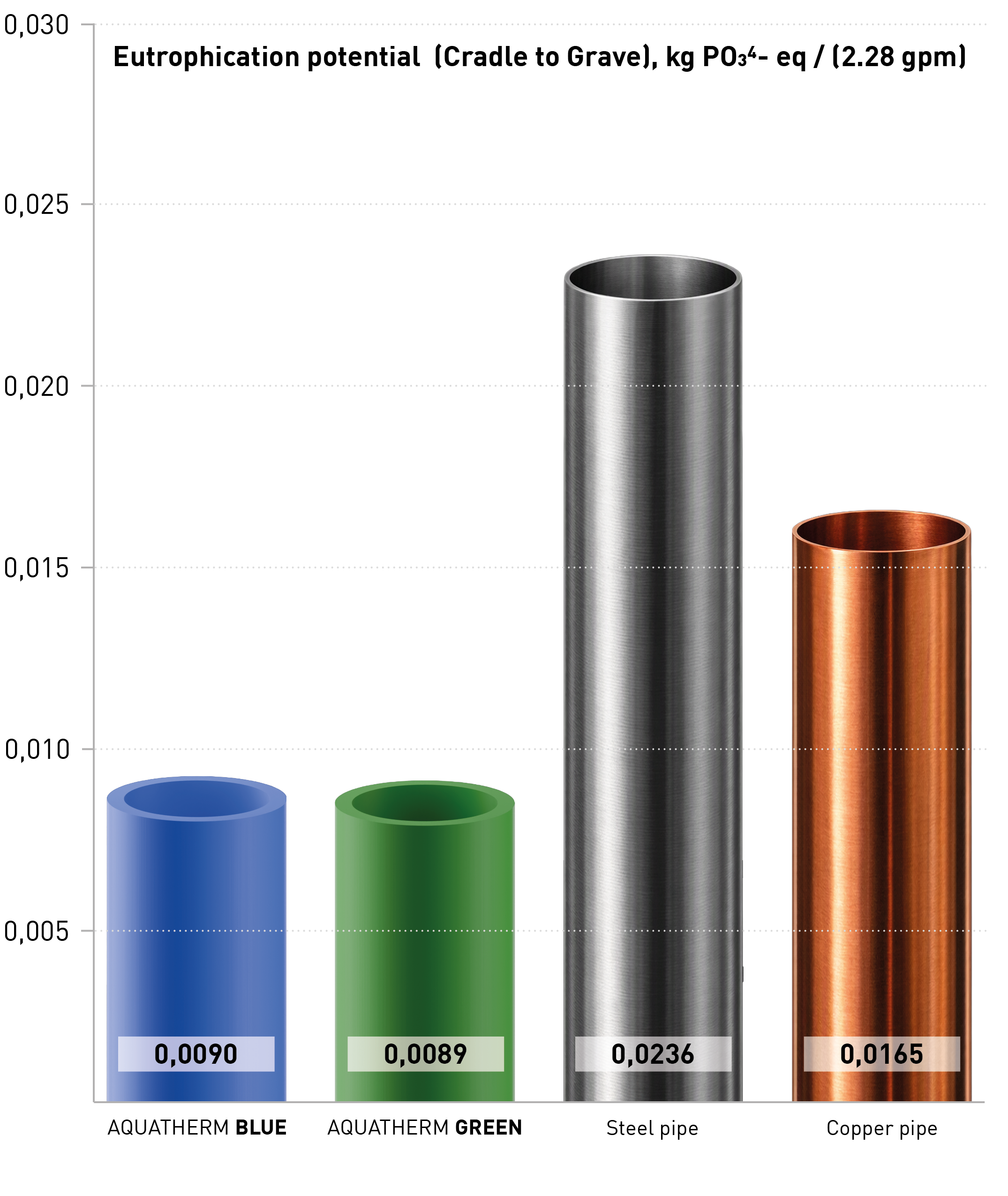
- Up to 54 per cent lower eutrophication potential, helping to reduce water pollution
aquatherm pipework systems in operation – economical, durable and safe
The following questions can be crucial for the overall assessment of a pipework system: How much energy do we need to use to operate the system, and how much energy is lost, for example, through waste heat? How resilient and durable is the system, and how do the operating parameters change over the years? aquatherm pipework systems provide solutions to these challenges.
The aquatherm black surface heating and cooling system, for example, is ideally suited for use with renewable energy sources, such as heat pumps. Depending on the nature of the ceiling, wall or floor structure, it operates at a flow temperature of just 25–30°C. With aquatherm blue, the excellent insulating properties of polypropylene are very evident. With a thermal conductivity of just 0.15 W/mK (by way of comparison, stainless steel has a thermal conductivity of up to 25 W/mK, unallyoed steel up to 45 W/mK, and copper up to 400 W/mK), aquatherm pipework systems can reduce energy consumption, costs and insulation requirements.
- Low thermal conductivity (0.15 W/mK)
- Corrosion-free
- Virtually no VOCs (volatile organic compounds)
- Service life: > 50 years
End of life – 100 per cent recyclable
An aquatherm pipework system can remain in service for many years before it needs replacing: according to our calculations, its service life is at least 50 years. Eventually, the question of recycling arises. The good news is that polypropylene can, in principle, be recycled as a raw material.
- 100 per cent material recycling is possible
Verified data – the Environmental Product Declaration (EPD) and the Life Cycle Assessment (LCA)
We have our pipework systems assessed by external institutes for their environmental impact in accordance with the EN 15804 and ISO 14025 standards, and publish the results as Environmental Product Declarations (EPDs). This provides our customers with the transparency required, for example, when participating in public tenders. In addition, we have carried out a life cycle assessment (LCA) to provide a detailed comparison of aquatherm polypropylene pipework systems with comparable copper, steel and PVC systems.
aquatherm – Solutions through commitment
Our polypropylene pipework systems offer clear advantages. At our sites, particularly at our headquarters in Attendorn, we implement a range of measures to reduce energy consumption and prevent waste. We continuously measure and evaluate these measures through our environmental management system in accordance with ISO 14001, our energy management system in accordance with ISO 50001 and our quality assurance system in accordance with ISO 9001.
As a result, by 2025, we had reduced electricity and gas consumption per tonne of polymers, additives, pigments, glass fibres and metals used – adjusted for climate and economic conditions – by 17 per cent compared with the 2022 reference year. While this may not sound like much at first glance, it represents a significant achievement given the limited technical possibilities.
Waste prevention plays a major role, particularly in the manufacturing process, and remains a high priority for us. In 2025, residual waste per unit of production material used (such as polymers, metals, additives and pigments) was significantly lower than in the previous year. With a scrap rate consistently below 7 per cent, we also avoid unnecessary waste in production. Waste cannot be completely avoided, but it can be returned to the recycling stream through separate collection by type. With a separate collection rate of almost 95 per cent, we are contributing to this goal.
- ISO 14001 Environmental Management System
- ISO 50001 Energy Management System
- Quality Management System ISO 9001
- 17 per cent reduction in energy consumption per tonne (compared with 2022)
- Separate waste collection rate: 95 per cent
- Scrap rate consistently below 7 per cent
FAQ
Yes. The production of aquatherm green generates around 35 per cent fewer greenhouse gas emissions than a comparable copper system. For aquatherm blue, CO₂e emissions are around 37 per cent lower than for a steel pipework system. All figures apply to the manufacturing phase (Cradle to Gate, Modules A1–A3). Over the entire life cycle, most emissions occur during this phase. The figures have been determined in accordance with EN 15804 and ISO 14025 and verified by external institutes.
Cradle to Gate’ describes all environmental impacts from raw material extraction to the product leaving the factory gates. It therefore covers manufacturing, but not use or disposal. In our Environmental Product Declarations (EPDs), prepared in accordance with EN 15804, and in our life cycle assessment (LCA), we record the environmental impacts from manufacture through to disposal (Cradle to Grave).
Yes. In addition to greenhouse gas emissions, the production of polypropylene generates significantly fewer sulphur and nitrogen oxides (60 per cent lower for aquatherm blue compared with steel). Polypropylene also performs better than steel, copper and PVC in terms of acidification and eutrophication potential. In addition, its significantly lower weight can reduce transport and installation costs.
Polypropylene is 100 per cent recyclable. At the end of its service life, the material can be ground into granules and reused as a raw material.
We estimate a service life of at least 50 years for our pipework systems. These estimates are based on various operating conditions relating to temperature and pressure Polypropylene does not corrode and is inert to a wide range of chemicals at different temperatures. The hydraulic properties remain stable throughout the service life.
Polypropylene has a lower thermal conductivity than steel and copper. Consequently, heat loss through the pipe wall is significantly lower than with metallic pipes. The thermal conductivity is 0.15 W/mK for PP, compared with up to 25 W/mK for stainless steel, up to 45 W/mK for unalloyed steel, and up to 400 W/mK for copper. This does not affect the applicable insulation requirements under the Building Energy Act.
aquatherm green is, amongst other things, DVGW-certified and approved for drinking water applications. It is regularly subjected to independent testing in this regard. Polypropylene is corrosion-resistant , contains no plasticisers that could leach into drinking water, and does not require additives during processing that could pose a hygiene risk.
Yes. The Environmental Product Declarations (EPDs) are available for download in our knowledge database under ‘EPDs and Certificates’. The EPDs provide key environmental indicators required for building certifications and public tenders in accordance with EN 15804 and ISO 14025. In addition, the life cycle assessment (LCA) for aquatherm blue and aquatherm green, compared with copper, steel and PVC systems, is available on request.
Between 2022 and 2025, we reduced electricity and gas consumption per tonne of raw materials used by 17 per cent, adjusted for climate and economic conditions. In 2025, energy consumption stood at 0.96 kWh per kilogramme of processed material. In terms of waste management, the separate collection rate was around 95 per cent and the production scrap rate was less than 7 per cent.
Polypropylene is produced from fossil raw materials. Nevertheless, its environmental impacts over its life cycle can be lower than those of copper and steel. For example, CO₂e emissions can be up to 37 per cent lower, while emissions of air pollutants such as nitrogen oxides and sulphur dioxide can also be lower. Consequently, potential environmental impacts such as the acidification, eutrophication and the formation of ground-level ozone can also be significantly lower. Furthermore, polypropylene pipes do not corrode and have a long service life, which we estimate to be at least 50 years.
Posts you might find interesting